2026-02-02
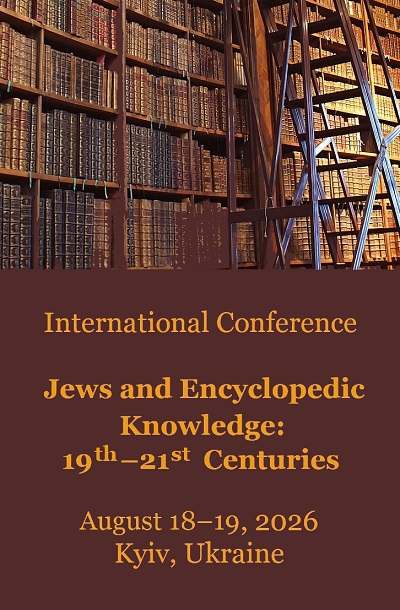
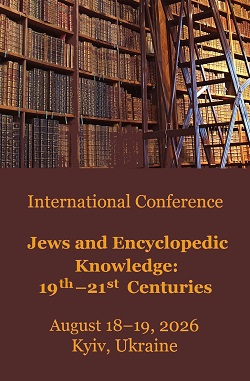
International Conference
Jews and Encyclopedic Knowledge: 19th – 21st Centuries
August 18–19, 2026
Kyiv, Ukraine
The conference is organized by the Ukrainian Association for Jewish Studies with the financial assistance of the European Association for Jewish Studies. This initiative is implemented in partnership with UNESCO with the financial support of the European Union.
The Ukrainian Association for Jewish Studies invites proposals for participation in the first international conference devoted to Jewish encyclopedias and Jewish topics in encyclopedias of the 19th and 21st centuries.
Since the 18th century, Jewish topics have been presented in general encyclopedias. Since the early 20th century, they also appeared in specialized Jewish reference publications. The most famous of these are the Jewish Encyclopedia (New York, 1901–1906, 12 volumes) and Ievreiskaia entsiklopediia Brokhausa i Efrona (St. Petersburg, 1908–1913, 16 volumes). Both of these publications, as well as similar smaller-scale ones such as Oẓar Yisrael (New York, 1906–1913, 10 volumes, in Hebrew), were produced by large teams of authors from many countries of the diaspora, as well as of Eretz Yisrael. It is noteworthy that the appearance of the first encyclopedias on Jewish topics in non-Jewish languages occurred simultaneously with the publication of the first modern encyclopedia in Hebrew. This was a consequence of the spread of the Haskalah movement from the late 18th through the 19th centuries.
In the 20th century, Jewish encyclopedic knowledge became more professionalized. During the interwar period, Jewish topics became more visible in general and specialized reference works in European countries and the US. At the same time, new reference books devoted exclusively to Judaica appeared. Among them are the German-language Jüdisches Lexikon, ed. by Georg Gerlitz and Bruno Kirchner in 4 volumes, 5 books (1927–1930), and Encyclopaedia Judaica, ed. by Jakob Klatzkin and Ismar Elbogen (1928–1933, 10 of 15 planned volumes were published), as well as encyclopedias published during WW2 in the United States and Latin America. As in the case of non-Jewish reference books, articles on particular aspects of Jewish life, including political groups and writers, were often written by representatives of Jewish political and literary circles. The quality of the articles often benefited from this choice, but this fact itself often raised legitimate doubts among readers about the authors’ neutrality. However, could it have been otherwise in conditions when Jews were still struggling for their own state, and some Jewish academic institutions were gradually gaining reputation in the academic world?
The situation changed dramatically after the Jewish state appeared on the world stage. Specialized and general reference books in Hebrew were published in Israel, followed by the publication of the first multi-volume general encyclopedia in Hebrew (1949–1985, 32 main and 5 additional volumes). Over the course of several postwar decades, dozens of reference books on Jewish history and culture were published in Hebrew, Yiddish, and several European languages around the world and in Israel. Unlike the early 20th century and the interwar period, most of the authors of such publications were scholars, and many texts on Jewish-related topics were written by non-Jews. Therefore, upon the proclamation of the State of Israel, the encyclopedic dimension of Jewish Studies was finally institutionalized. This situation persists in the early 21st century. In addition, the collaborative nature of Wikipedia, characterized by entries authored by collective teams rather than individual contributors, represents a novel shift in encyclopedic development.
The conference will discuss the following aspects of the topic “Jews and encyclopedic knowledge”:
- history of Jewish encyclopedias in Europe, Eretz Yisrael, and the Americas;
- editors of Jewish encyclopedias and the authors of entries (Jews and non-Jews, scholars and authors from outside the academy, and so forth);
- representation of Jewish topics in general and specialized encyclopedias in non-Jewish languages;
- phenomenon of translated Jewish encyclopedias;
- institutional dimension of Jewish encyclopedias (publishers, research institutions, funding, etc.);
- role of the editor in the history of Jewish encyclopedias;
- role of encyclopedias in the development of Hebrew and Yiddish academic terminology.
The conference will host a roundtable devoted to the Bibliographic Database “Jewish Studies in Independent Ukraine”, a UAJS project implemented in partnership with UNESCO with the financial support of the European Union. The project’s team will present the results of the project, including the database website.
The organizers will also publish a collection of articles before the conference. The participants are encouraged to submit their articles in English or Ukrainian by June 10, 2026. Papers that will be selected by the editorial board should have 5,000 to 8,000 words and be designed in accordance with Chicago Manual of Style.
The working language of the conference is English.
Ukrainian can also be a working language for the roundtable within the conference.
The application deadline is April 10, 2026.
Responses will be sent to the applicants by April 20, 2026.
The organizers will cover accommodation and meals for participants. There are a limited number of travel grants and priority will be given to PhD students, young career researchers, and independent scholars without institutional support from Eastern and Central Europe.
The registration form can be found here.

For other questions, please contact the Organizing Committee at conference@uajs.org.ua.